Pages

Showing posts with label maiden flight. Show all posts

Wednesday, November 29, 2017

Buzzard Bombshell Electric Conversion and Mods

About a year and a half ago I picked up this wonderful high wing balsa old timer at a swap meet.  I did not know what it was but I'm a sucker for an inexpensive balsa old timer, especially a three channel high wing.  He wanted $25.  I offered $15.  He threw in a motor, esc, and two servos and we settled for the $25 he was asking!  I was a happy camper.

After some time and a bunch of Internet searching, I finally discovered that what I had bought was a plane called the Buzzard Bombshell.  The original design was done and built by Joe Konefes in 1940  with about a 72 inch wing span.  It was intended as a free flight as RC gear was way too expensive for most people.  This plane was designed to head up as high as so many ounces of fuel would take it and then glide for as long as possible (Joe flew his for over 49 minutes at the 1940 NATS).  To help with extended glide times they incorporated large tail surfaces that helped with lift and moved the CG to 50% or more back from the leading edge.  With the heavy motors of the time, this made for an interesting stubby nose look.

Mine was a more current and smaller version that was intended for 1/2A power sources.  It looks like it was setup for a Cox .049 judging from the mounting holes in the firewall.  Now by smaller I mean about a 45 inch wing span and still a good size plane.


Didn't realize that these cluttered photos were the only ones that I had at the time I posted this.


I'll take some better ones as soon as I get some time.

A couple of things that I really liked about this plane is that the builder did a pretty good job of construction and covering, but also, I see no oil residue and so don't think that a motor was run on this plane let alone even mounted.  I don't think it has ever been flown.

The first thing I looked at doing was to figure a motor mount


You can see here the holes for the original motor mount.  Fortunately the builder install blind nuts from the back side.  I just needed to figure out what size they are and how to go about using them.  They are oddly laid out so I can't directly use them and I'll need an adapter.


You can see the blind nuts in this photo.


I decided to use a circle of 1/8 inch plywood.  I would drill holes to line up with the engine mount holes and then drill holes to fit the electric motor mount.


I lined up the disk from the back side so that I could transfer the mounting holes from the front side.


Here is what I came up with.  I started counter sinking the holes so that I could use flat head screws so that it will fit flush against the firewall.


Here are the parts that I came up with to create my motor mount.  I ordered some aluminum stand offs from an online source and screws and washers from my local hardware store.  As I recall all of the threads turned out to be a standard 10-24.


Here is how the stand offs will fit with the electric motor x mount and the original motor mount.


This is how it would look with the longer stand offs.


Here is the new round plywood mount test fitted in place.


I needed to ream out the x mount slightly to fit the new screws.


Now the screws fit fine.


Here are the different stand offs and screws that I used.


Here is how it would look with the long stand offs.


This is how it would look with the short stand offs.  I like this look better, it puts the propeller closer to where it would have been with the originally designed gas motor.


I used different amounts of washers behind the x mount arms to set down and left thrust angles.


Here is the end result.

Now I need to start looking at where and how to mount the battery, ESC, and the two servos before I can get this thing back in the air.  These will be done in future updates.

Thanks for stopping by my blog.  Please feel free to post comments, good or bad, and be sure to come back and check for future posts.

Wednesday, November 2, 2016

Wing One Rebuild (Say that fast 5 times)

This beauty was my next project!

This wing came to me from the second owner who had not actually done anything with it.  He reported that the original owner had flown it with some sort of pod on top that housed the battery, electronics, and motor.  The pod and what was contained were no longer with this wing.  It did show signs of having been flown but was still in really good shape.

Here I started to take the covering film off of the trailing edge of the section between the elevons.  I started to do this because I knew I would need to take this section out to be able to move the motor forward.  I wanted to move the motor forward because I also knew it was going to be hard enough to get the CG right without the motor being so far back.


Here is a closer look after I had cut the trailing edge balsa lose.  I also have the motor/prop combination that I intend to use and the start of a motor mount/firewall.


Here I'm getting an idea of how things will line up.


Here is how I originally thought everything might lay out.


To provide for some flexibility in the power system (in anticipation of crashing), I decided to use a block of stiff foam to mount the firewall.  I cut out the covering film where this foam block will be glued down.


I decided to use Gorilla glue to secure this block as it would expand into the foam as well as adhere to the wood and foam of the wing.  Also, Gorilla glue is more flexible than epoxy (remember the anticipated crashing?).  I used the popsicle stick to help spread out the glue.  I did not show these steps, but I also spritzed it with water to help activate the glue and then held everything in place with masking tape.
(Our cat Dewy is trying to get in on the action)


Here is all of the pieces glued in place.  I made sure to have the motor wires run over the top just because I though it would make it easier to connect up.  Also, you can see the slight up tilt in the motor.  This was done to keep the thrust line pointing to the center of mass.  If you do not do this with a pusher, you will get pitching up or down when applying power.


After doing some CG work (I used an online CG calculator for flying wings to come up where the CG should be for this wing.  I think I used one of these: wingcgcalc and fwcg), I realized that the battery would need to mount like this to get the CG right.  I centered the battery and then traced around it and dug out the foam about half an inch down.  I did not want to go too far into the foam so as to maintain as much strength as possible while still providing a good battery mount.  You can see that I glued some bamboo skewers into the long corners of this cutout.  I also wrapped a strip of velcro around each of these.  I thought that these would help reinforce the foam and help to secure the battery.  This actually worked very well.


Here is a closer look.


 Here the battery is strapped in.


Here I am out for the maiden flight.  A friend who is a really good wing pilot got it up in the air for me and then handed the controls over after he trimmed it out.  Thanks Richie!
If flew great and he was easily able to launch it and trim it out.  I came down a bit hard on a landing and loosened the glue on the firewall.  I just used a couple of rubber band from front to back to secure it and that is what you can see here.  I did this because I was not ready to go home and really wanted to continue flying!
(Editorial Note: I am not condoning the flying of damaged airplanes in any way!)


  It flew great just like this for two flights.  Then I came in rough again and encountered the damaged prop and completely broken loose firewall that you can see here.


Here it is again all rebuilt and ready for another day of flying.

I have been really impressed with how durable wings can be.  I have continued to fly this wing just as it is for many flights including some nasty crashes.  My worst crash was at a pretty good speed into a street curb.  The crash destroyed the battery and broke the hinges on one elevon and the related clevis.  I have since replaced the battery repaired these and flown it again.

Thanks for stopping by my blog.  Please feel free to post comments, good or bad, and be sure to come back and check for future posts.

Foamy Rehab 2

Part II

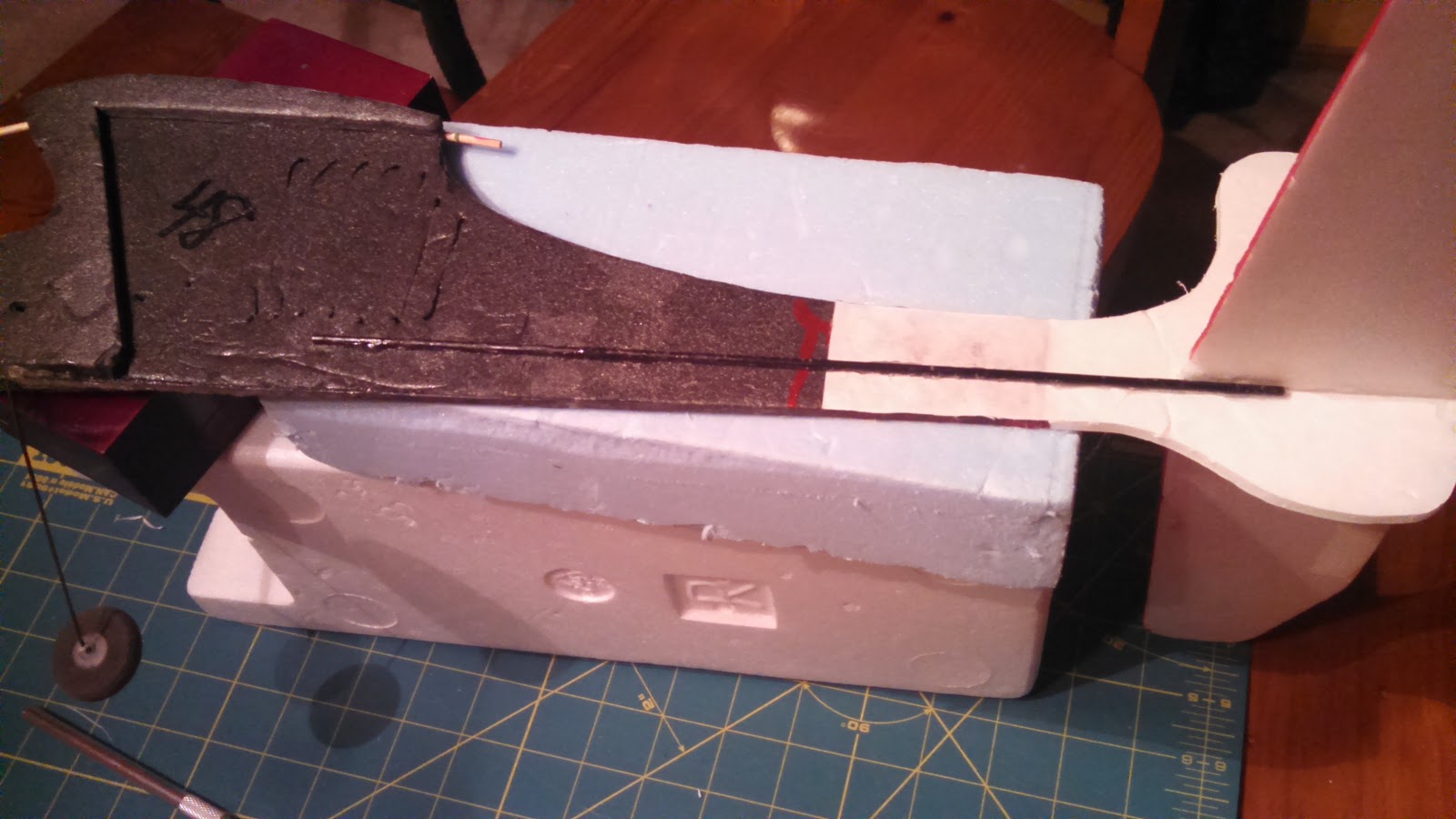
At this point, the carbon rod spar was glued back in place on the opposite side of where it was originally as this surface was clean and flat.  Instead of the brittle epoxy, I opted for Foam Tac which will be more flexible on top of being easier to use.

With the adding back of the carbon fiber spar, the frame reconstruction of this little plane is complete.

Now on to the control surfaces and electronics.

On the left in the photo below are the old servos that came with it.  They were a weird mix and I did not want to rely on them.  I happen to have two new 4g servos on hand and decided to swap them out.


Here is a photo showing the ESC and old servos again.  Note the micro connectors.


This photo shows the size difference in the connectors.  They are much smaller but I was not going to be able to use the 72MHz mircro receiver that came with it (I sold this receiver along with another on Ebay for about $20!).


Here is the new 4 channel receiver that I will be using with the two new micro servos installed.  The old ESC still has the micro connector.  I'll have to replace this connector as I don't want to replace this ESC as it already has all of the other connectors soldered on and I would have to get these as well.

OK, on to the tail surface repairs that I decided to make as well as changes to the control horn installs.

There were some dings in the leading edge of the stabilizer that I fixed by applying Gorilla glue and then covering with masking tape.  I let the glue foam up and then trimmed and sanded to shape.


I removed the elevator so that I could redo the hinge tape (pretty much rotted apart) and install a new control horn.  You can see here that the rudder just uses the paper on one side of the foam board for the hinge.

Here I'm cutting pieces from a plastic card to make the parts I need.  I kind of played with the shapes until I was satisfied.

I used this method (Ed from Experimental Airlines, thanks) where it glues on one side and penetrates to the other.  This makes for a light but solid horn.  I cant remember if I used hot glue or Foam Tac for this, but either should work well.  For the hinge on this piece I just use Scotch tape!  Works just fine for this little guy.


Here I did the same for the rudder making sure that at least one of the holes lined up with the hinge point.  You can see that it had to sweep forward to achieve this while not interfering with the cut out on the other side.


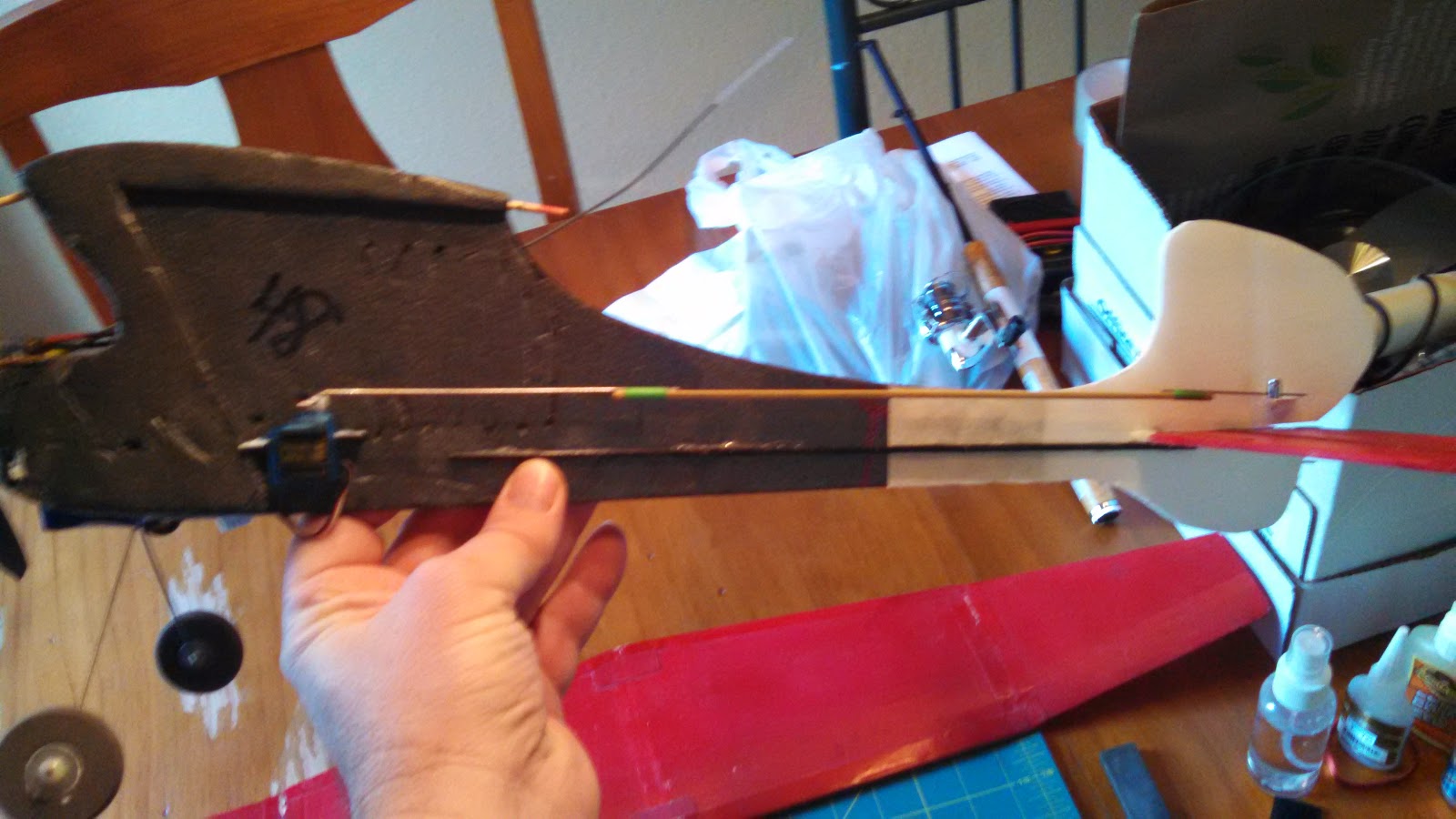
I did not want to just glue the servos to the side like had previously been done so I cut some strip of the plastic card and slid them through some slots in the fuse.  These were glued in with hot glue and provided perches for the servo tabs.  The servo tabs were then hot glued to these.  The photos below show both sides.


The push rods extend a long way and the old ones flexed a lot so I attached wires to the ends of some bamboo skewers to make fairly rigid replacements.


Here they are attached to both servos and control surfaces.  I used "Z" bends and mini "E/Z" connectors.  This made it much easier to make adjustments.


Here is a photo with all of the other electronics stuck on.  I used velcro for the receiver, ESC, and battery.  The battery is way forward so as to get the CG close.  It's still a little tail heavy.  As for the CG, I just kind of guessed assuming that it should be between 25 and 30% back from the leading edge.


This is what it look like with the wing balanced on.  I did not have a rubber band available, but this is what it looks like.


It's all ready to go now.  Just need a nice day and the battery charged.

I have since flown this little thing and I have to say that it is a real kick in the pants to fly.  Looks like it would be too light for any wind but surprisingly enough it handles the wind quite well.  I actually love taking this thing out and flying it when others won't because it's too windy.  One caveat is that it flies well once you get it nosed into the wind!  Otherwise your fighting to keep it from tumbling.  But hey, isn't that part of the fun!

Anyway, I hope this has inspired you to have fun with this hobby and to not be afraid of taking on what may seem like a piece of junk!

Thanks for stopping by my blog.  Please feel free to post comments, good or bad, and be sure to come back and check for future posts.